
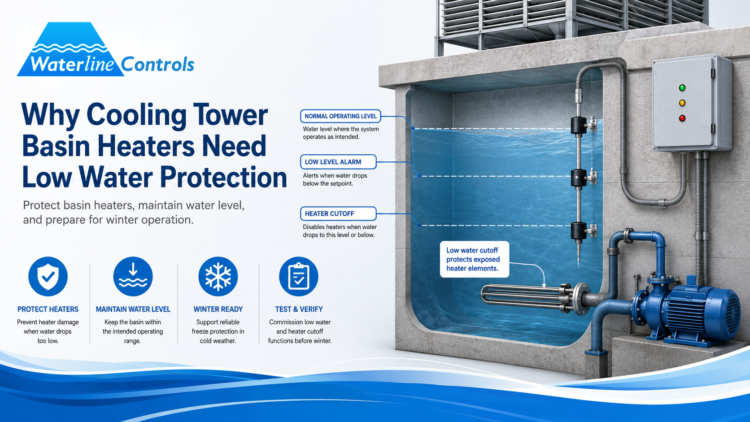
Cooling Tower Basin Heater Low Water Protection
Cooling tower basin heater low water protection is a level control function that switches the basin heater off when the water falls to a minimum safe level, before the heating elements are uncovered. A basin heater is designed to keep basin water from freezing. It is not intended to heat an empty basin.
That makes water level supervision an important part of winter operation. If the basin level drops far enough to uncover the elements, continuing to energize the heater may damage equipment or create an unsafe operating condition. The heater control sequence should therefore consider both temperature and water level.
Basin Heaters Need Water Around the Elements
Cooling tower manufacturers treat low water protection as part of basin heater control. Some basin heater control panels use a single probe to sense both water temperature and water level, and manufacturers describe low water cutouts as part of proper heater operation: the cutout keeps the heater from running below the safe water level.
The heater should not rely only on outdoor air temperature.
When Should a Basin Heater Turn On?
A basin heater normally operates only when conditions are cold enough to require freeze protection.
One cooling tower manufacturer, for example, designs its basin heaters to maintain 40 degrees Fahrenheit basin water at a 0 degree Fahrenheit outdoor temperature, and energizes them only when the condenser water pumps are off and no water is flowing over the tower.
The exact temperature control must follow the cooling tower and heater manufacturer’s instructions. The level control system provides the additional protection needed if water falls below an acceptable point.
Set the Basin Heater Cutoff at a Safe Water Level
Normal makeup control should restore the basin before the heater protection point is reached.
Where the approved elevations allow it, place fill start above the low level alarm and the low level alarm above the heater cutoff. Set the cutoff at or above the heater manufacturer’s minimum safe water level.
The WLC-6000 water level controller combines fill control with high, low and low-low alarms, and its low-low output can serve as the heater cutoff when the approved wiring interlocks it with the heater control circuit. The WLC-6100T controller adds a water temperature sensor and heater control to fill control and high and low alarms. Its installation instructions describe the sequence: the heater relay energizes below 40 degrees Fahrenheit when the water is above the safe operating level, and low water disables the heater.
The final elevations should come from the equipment design rather than generic dimensions. Our water level sensor placement guide for level controls covers general placement principles for fill and alarm points.
Do Not Let a Low Alarm Become Routine
A low level alarm should indicate abnormal operation.
If it activates every time the tower starts, the operating range, makeup capacity or sensor elevations need review. The basin may be losing water into circulation faster than makeup can respond, or the valve may not be supplying enough flow.
Frequent low alarms during normal operation can lead operators to ignore a genuine low water alarm.
Test the Fill Valve Before Winter
Automatic fill cannot restore the basin level if the makeup valve cannot deliver water.
Before freezing weather arrives, test the valve, strainer and water supply, and check that the makeup supply maintains the specified basin water level.
Verify that flow stops after the valve’s specified closing time. For controlled closure and water hammer, see why slow closing fill valves matter for water level control.
Confirm the Heater Cutoff Function
Do not assume the low water protection works because the indicator light turns on.
Commissioning should verify that the heater control circuit actually responds to the low water condition.
The WLC-6100T has a press-to-test button. Its instructions describe a test of about two minutes that steps through the heater, low alarm, fill and high alarm outputs and cannot be interrupted once started. Before starting the test, coordinate with the BMS operator and secure connected loads under the approved test procedure.
The test checks the controller from the sensor wire connections to the output relays. It does not prove the probe elevations or the heater wiring, so separately verify the installed cutoff elevation and confirm that the heater contactor drops out under the approved low water test while the elements remain submerged.
Document the final level and temperature sequence for maintenance staff. The water level control commissioning checklist covers the rest of the acceptance test.
Prepare Cooling Tower Controls for Winter
Waterline Controls manufactures frequency-based electronic cooling tower level controllers, including the WLC-6100T with automatic fill, high and low alarms and basin heater control. Verify that makeup water and heater protection work together before freezing weather. Call 480-905-1892 to discuss your cooling tower, basin heater, sensor levels and winter control sequence.
References
WLC-6100T water level controller with basin heater control
WLC-6100T controller installation instructions
WLC-6000 water level controller with low-low alarm
Basin heater sensing and low water cutouts (Baltimore Aircoil)
Makeup water supply maintenance for evaporative cooling equipment (Baltimore Aircoil)
Cooling tower basin heater design conditions (EVAPCO operation and maintenance)