
Why Slow Closing Fill Valves Matter
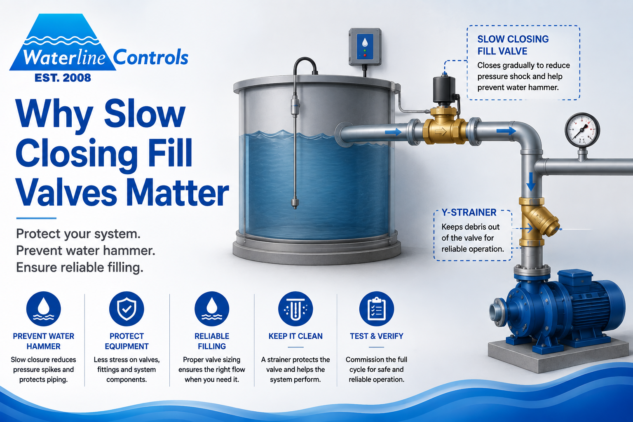
Water hammer is a pressure surge that occurs when moving water is stopped too quickly. The level controller may tell a fill valve exactly when to close, but the valve still has to stop the water in the pipe.
When a large flow is stopped very quickly, the resulting pressure change can create water hammer. Operators may hear a bang in the piping, but the concern goes beyond noise. Repeated pressure shock can place unnecessary stress on piping, fittings and valves.
For automatic tank and cooling tower fill systems, valve behavior deserves attention during design.
Fast Closure Can Create Pressure Shock
Water has momentum while it is moving through a pipe. A quick closing valve changes that velocity rapidly.
Watts, in its water hammer arrestor literature, explains that a sudden stop from a fast closing valve creates a shock that can damage pipes and appliances. The same surge occurs on large makeup lines.
Higher flow velocity and rapid valve closure increase surge risk, so pipe length, diameter, material, operating pressure and closure time should be evaluated together.
The required valve and surge control method depend on system pressure, pipe size, velocity and layout.
Slow Closing Solenoid Valves Reduce the Sudden Change
A slow closing valve does not simply delay the controller command. It changes how the valve physically reaches the closed position.
Emerson’s ASCO 221 series is specifically designed as a slow closing water solenoid valve. ASCO documentation states that its closing mechanism reduces the pressure spike associated with water hammer.
Waterline Controls offers slow closing valves for level control systems as accessories for its electronic level control systems.
The valve still needs to be sized for the actual application.
Match the Valve to the Water Supply
Do not select an automatic fill valve solely from the pipe diameter shown on a sketch.
Review required flow and Cv, minimum and maximum differential pressure, valve pressure rating, electrical supply and the time available to refill the basin or tank.
An oversized valve can raise velocity and overshoot the stop level while it closes, while an undersized valve can make recovery unnecessarily slow.
The project engineer should also confirm any requirements for backflow prevention and water supply protection.
Protect the Valve From Debris
Automatic valves work better when debris is kept out of the internal components.
Waterline Controls drawings commonly show a Y strainer upstream of the fill valve. The company also provides strainers and valve accessories for its systems.
A strainer still needs inspection and cleaning. A blocked strainer can reduce makeup flow and create a low level problem even when the controller and valve are operating correctly.
Watch for More Than Water Hammer
A fill problem can show up in several ways.
A valve that does not close completely may cause the level to creep upward after the controller has stopped calling for water. A valve that opens slowly or has inadequate flow may allow the basin to fall toward the low alarm during heavy demand.
The control system should therefore be commissioned as an assembly rather than testing the sensor and valve independently.
Verify the Complete Fill Cycle
Operate the system through a full cycle.
Confirm the controller calls for fill at the correct level, the valve opens fully, the water level recovers and the valve closes without excessive shock.
Then confirm that the high and low alarms remain outside the normal operating range.
If the BMS receives fill status, verify that point as well.
Fill Controllers, Slow Closing Valves and Strainers
Waterline Controls manufactures frequency-based electronic fill controllers for cooling towers, tanks, fire protection water tanks and other commercial applications, including the WLC-5000 fill controller with high and low alarms. The company also supplies valves, strainers and related accessories. If your project requires reliable automatic filling or you are dealing with repeated valve problems or piping shock, call 480-905-1892 to discuss the controller, valve type, operating levels and system requirements.