What BMS Points Should a Water Level Controller Report?
Connecting a water level controller to a building management system should do more than create another green icon on a screen. The purpose is to give operators useful information about what the tank or basin is doing and whether the level control system is responding correctly.
A good point list begins with the sequence of operation. The engineer should decide which conditions need remote supervision, what each point means and how the BMS should respond when that condition changes.
Report the Actual Control Functions
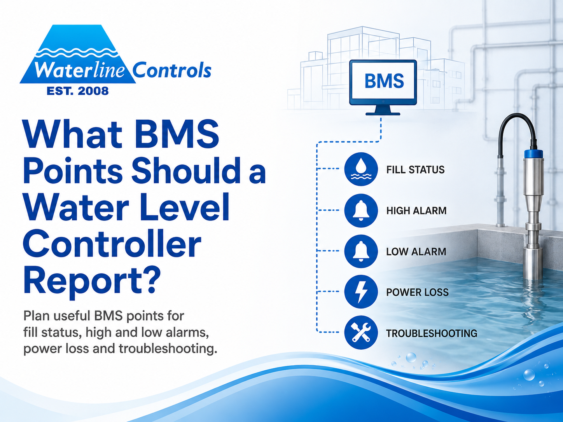
For a typical automatic fill application, useful points may include fill status, high water alarm and low water alarm.
Waterline Controls uses dry contacts for remote signaling on many WLC models. The WLC-5000 fill controller, for example, provides four dry contacts. One reports power loss while the remaining contacts correspond to the control functions. The controller itself performs fill control and provides high and low level alarms.
That gives the BMS information beyond simply knowing that the controller has power.
Separate Status From Alarm Conditions
A fill signal should normally be treated differently from a high water alarm.
Filling can be a routine part of operation. A high or low alarm indicates that the water has moved beyond the expected operating range.
Point names should make that distinction clear. Instead of using a vague description such as Tank Status, use names that identify what actually happened. Examples might include Cooling Tower Fill Active, Cooling Tower High Level and Cooling Tower Low Level.
This makes alarm histories much easier to understand months later.
Include Power Loss or Controller Trouble
A controller that has lost power should not appear healthy simply because no level alarm is active.
Waterline’s WLC-5000 submittal identifies a dedicated power loss and fault dry contact. Its documentation also shows the intended normal and power loss states of that contact.
The BMS programmer should document how that signal is interpreted. Operators should be able to distinguish an actual water level problem from a controller that is unavailable.
Document the Contact State
The drawings should identify whether each contact is open or closed during normal operation and what happens when the associated condition becomes active.
Do not make the controls contractor determine this from assumptions in the field. Waterline submittals provide function information for the dry contacts, and the final BMS point list should match the selected controller and approved sequence.
This becomes particularly important when alarm logic is designed to respond differently to loss of power.
Decide What the BMS Should Do With the Information
Bringing a point into the BMS does not automatically make it useful.
Decide whether the condition should produce an alarm, create a maintenance notification, start a trend or simply display status.
Fill activity can be trended over time. Waterline notes that fill dry contacts on several models can be used comparatively to establish a baseline for system water use.
A sudden increase in fill activity can then become a reason for investigation rather than something noticed only after a water bill rises.
Test Every Point During Commissioning
Commissioning should verify the entire signal path.
Simulate each operating condition and confirm the controller indication, dry contact and BMS point all change as intended. Test high level, low level, normal fill operation and power loss where those functions are provided.
Waterline controllers include a test function on many models that can sequence control outputs for system verification.
Record the final point names and contact states in the facility documentation.
Specify BMS Integration With Waterline Controls
Waterline Controls manufactures electronic water level controllers for cooling towers, water tanks, fire protection systems, sumps, wastewater applications and other commercial systems. Many WLC models provide dedicated dry contacts for BMS, BAS or other remote monitoring systems. Call 480 905 1892 to review the required control functions, remote points, sensor arrangement and sequence for your project.
References
WLC-5000 water level controller with high and low alarms