
Fire Water Tank Level Monitoring Guide
A fire water storage tank is not an ordinary process tank. Its level has to remain available for an emergency, while abnormal conditions must be reported clearly enough for facility staff to act. A gauge that only shows one condition at the tank may not provide the supervision, automatic filling and remote signaling expected for the project.
The final design depends on adopted codes, the fire protection plan and the authority having jurisdiction. A useful specification gives that team clear options instead of treating level control as a late plumbing accessory.
Confirm the Required Operating Level
Begin with the fire protection engineer’s required usable water volume and normal level. Controller setpoints should relate to that design, tank geometry and the elevations shown on the approved drawings.
NFPA guidance for fire protection water storage tanks addresses maintaining the required water level and supervising tank conditions. The local fire marshal may apply a particular adopted edition and local amendments, so the specification should not rely on a generic online diagram.
Define High, Low and Low Low Conditions
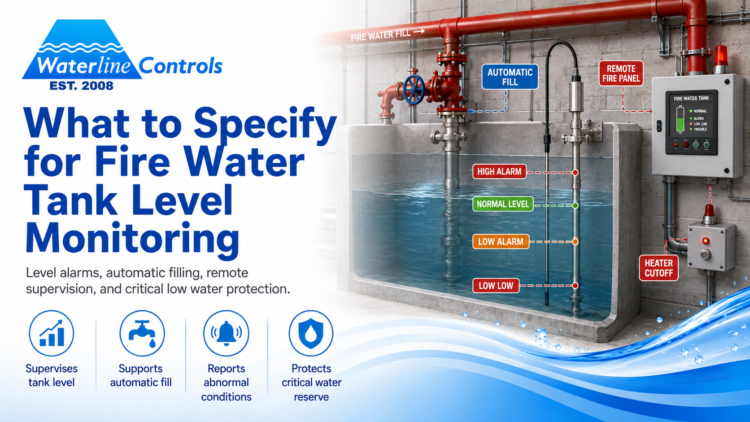
A low level alarm warns that available fire water has fallen below normal. A high level alarm can identify a fill valve problem or another condition that may cause overflow. Some projects also use a low low point for additional protection or heater cutoff.
Alarm descriptions should be specific. “Tank trouble” gives the operator little direction. Separate high, low, low low and power loss signals allow the remote system to display the actual condition.
Waterline Controls offers FPT fire protection tank level controllers with combinations of high alarm, low alarm, low low alarm, automatic fill and heater cutoff. The correct model depends on the approved sequence and which functions are handled elsewhere.
Decide Whether Filling Is Automatic
An automatic fill controller can open a valve when the level falls and close it after the normal level returns. That function should be coordinated with the water supply, valve type, backflow protection and municipal requirements.
Automatic filling does not replace supervision. A valve can fail, the supply can be interrupted or the tank can lose water faster than it is replaced. The remote system still needs to report abnormal conditions.
Plan Remote Fire Panel Connections
The level controller should connect to the approved remote fire panel or supervisory system using the required contact arrangement. Waterline Controls states that its FPT series integrates with existing remote fire panels. Potter also offers a float operated supervisory switch specifically for sprinkler supply tanks, showing that tank level is treated as a dedicated supervisory function.
Create a point list showing each signal, normal contact state and destination. Include controller power loss when required. The fire alarm contractor, electrical contractor and level control supplier should review the interface before installation.
Protect Against Power Loss and Cold Conditions
A level system that loses power should not appear normal. Decide how the panel will indicate loss of controller power and whether the remote signal is fail safe.
In cold climates, a tank heater or related equipment may need protection when water falls to a critical level. Waterline Controls offers the FPT-61T level controller with heater cutoff alongside high and low alarms. Heater operation and low water protection should follow the project design and equipment instructions.
Choose Sensor Locations Carefully
Sensor elevations should be measured from a fixed tank reference and documented on the approved drawing. Avoid placing the sensing assembly where incoming water creates misleading turbulence or where internal piping or maintenance work can damage it.
The sensor material and mounting assembly should suit the tank and water. Future access also matters. A technician must be able to inspect and test the system without removing unrelated equipment.
Commission Every Function
Testing should simulate each level condition and confirm local indication, fill valve response, remote panel signal and alarm restoration. Test power loss and any heater cutoff or low water interlock.
Record the final sensor elevations, relay states and sequence of operation. Facility staff should know how to use the test feature and how often the system must be inspected under the applicable fire protection program.
Specify Fire Tank Controls With Waterline Controls
Waterline Controls manufactures electronic FPT level control systems for fire water tanks, including alarm only models and configurations with automatic fill, high and low alarms, low low indication and heater cutoff. The systems are assembled in the United States and designed for remote panel integration. Call 480 905 1892 to discuss the approved sequence, tank dimensions, sensor arrangement and municipal requirements for your project.