Cooling Tower Remote Sump Level Control Guide
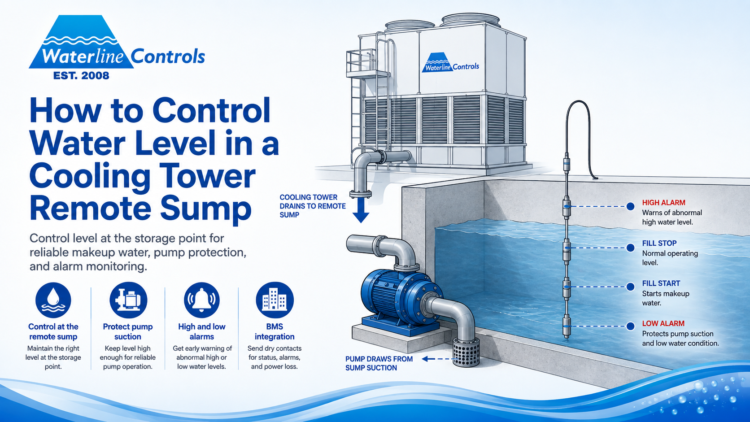
A remote sump is a separate tank that holds a cooling tower’s operating water, pump suction and makeup connection in place of the tower’s own cold water basin. A cooling tower does not always store circulating water in that basin. Some systems drain to a separate remote sump, where the pump suction, makeup water and operating storage are located away from the tower.
That changes where water level should be controlled. The useful measurement is the level that protects the remote sump and keeps the circulation system operating properly.
Understand What the Remote Sump Is Doing
During operation, water is moving through the cooling equipment, piping and spray system before returning to the sump.
EVAPCO engineering information for remote sump arrangements notes that additional water has to remain in the remote sump to cover the pump suction and strainer during operation. Its remote sump arrangements use an enlarged outlet so water can drain from the evaporative equipment to the separate sump.
The engineer therefore needs to consider both stored water and water that is temporarily in circulation.
Control Level at the Actual Storage Point
If the operating water is held in the remote sump, the level sensor should normally supervise that vessel rather than an inactive basin elsewhere in the system.
Waterline Controls specifically lists remote sumps among the HVAC applications for its electronic water level controllers. The same product family is used for cooling tower basins, evaporative condensers and closed circuit fluid coolers.
The sensor elevations should be based on the sump geometry and approved operating level.
Allow for Water in Transit
When circulation begins, some water leaves the sump and occupies the piping and cooling equipment.
The sump level may therefore fall even when the system has not lost water. Waterline Controls covers this effect in more detail in water in transit and cooling tower level control.
If the makeup control is set without considering that normal change, it may add more water than the system needs. When the pumps stop and circulating water drains back, the sump can then rise considerably.
The sequence should be reviewed under both running and shutdown conditions.
Protect Pump Suction
The low operating point needs to leave enough water over the pump suction for reliable operation.
EVAPCO’s engineering guidance specifically tells designers to allow additional water in the remote sump to cover the pump suction and strainer.
A separate low level alarm point can provide warning before the usable reserve reaches an unacceptable condition.
The pump manufacturer’s minimum submergence and suction requirements should also be followed.
Add a High Level Alarm
A high level alarm can identify excess makeup, a fill valve that does not close, heavy drainback or a blocked overflow.
The alarm should normally sit above the regular fill stop level so ordinary makeup operation does not create nuisance alarms.
The WLC-5000 level controller combines automatic fill with high and low alarms and provides dry contacts for BMS monitoring.
Those discrete outputs allow the BMS to report fill, high alarm, low alarm and power loss status.
Consider Shutdown and Winter Operation
A remote sump arrangement may also be selected to move water indoors or into a protected location during cold weather.
EVAPCO’s remote sump notes say the unit’s spray pump, suction strainer and associated piping are omitted from the unit and provided at the remote sump instead, and an oversized outlet is used so the equipment can drain to the sump. EVAPCO also describes a remote sump as a way to keep recirculating water out of the basin in cold weather. Shutdown and freeze protection still have to be designed for the whole system.
Level control should therefore be coordinated with the entire seasonal operating sequence.
Test the System in Both Conditions
Commission the system with circulation operating and again as the system shuts down.
Confirm the normal operating level, makeup start and stop points, low alarm, high alarm and the level reached after drainback.
Record those observations for future operators.
Level Control for a Cooling Tower Remote Sump
Waterline Controls manufactures frequency-based electronic water level control systems for cooling towers, remote sumps, evaporative condensers and closed circuit fluid coolers. Systems are available with automatic fill, high and low alarms and dry contacts for building automation. Basin heater control is a separate option and is often unnecessary when the sump is indoors. Call 480-905-1892 to review your remote sump dimensions, operating levels, sensor arrangement and BMS requirements.