
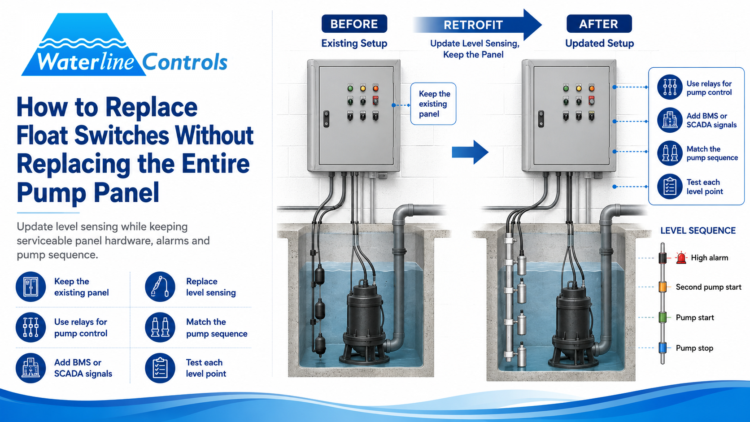
Float Switch Replacement for an Existing Pump Panel
Float switch replacement in an existing pump panel changes how the panel senses water level while keeping the motor starters, overloads, disconnects and wiring that are still serviceable. A troublesome float switch does not automatically mean that every component in the pump control system has reached the end of its useful life.
If the existing power components remain suitable, it may be possible to update level sensing while retaining much of the existing control equipment. The retrofit still needs to begin with the existing sequence.
Document What Every Float Does
Before removing anything, identify each float and the condition it controls.
A commercial sump may have separate points for pump stop, pump start, second pump start and high level alarm. Other systems may use floats for filling or low level protection.
Do not assume wire color identifies function.
Trace the circuits and compare them with the panel drawings. If the drawings no longer match the installation, update them before designing the replacement.
Keep Pump Power Separate From Level Sensing
The level sensing circuit tells the system what the water is doing. It does not necessarily carry the motor load itself.
Large pumps commonly operate through motor starters or contactors sized for the equipment.
Documentation for the WLC-9100 duplex pump-down level controller notes that its relays can be used as pilot relays for properly rated pump contactors.
That means the existing power hardware may remain part of the final design when it is in good condition and properly rated.
Match the Existing Sequence
A replacement level system should reproduce the required operating logic rather than simply copying the physical locations of old floats.
Waterline Controls offers simplex and duplex pump-down controllers, with high and low alarms available on selected models. Their dry contacts can report status to an existing control system.
If the old arrangement alternated pumps or used staged starts, select the new controls around that requirement. On the WLC-9000 A/C duplex pump-down controller, the A version is sequenced and the C version alternates. On the WLC-9100, A and B are sequenced and C and D alternate. Confirm which suffix matches the existing panel logic.
Check Sensor Cable Routing
Electronic sensing introduces its own installation requirements.
Waterline Controls installation instructions call for the sensor cable to run in earth-grounded metal conduit, separate from the conduit that carries high voltage lines, to reduce unwanted interference.
A retrofit is a good opportunity to correct questionable cable routing left from previous modifications.
Decide Which Signals Go to SCADA or BMS
Older float panels may provide only local lights or alarms.
An updated level control can add dry contacts for remote monitoring without requiring the BMS to control the pump sequence itself.
Possible points include pump calls, high level, low level and controller power loss, depending on the selected model.
Keep the local automatic sequence capable of doing its job even if remote monitoring is unavailable, unless the project design intentionally says otherwise.
Test Each Level Point
Commission the retrofit one function at a time.
Raise or simulate the water level and verify pump start, second pump operation, alarms and shutdown. Test manual controls separately.
Then verify the remote signals. For point-list details, see which BMS points a water level controller should report.
Where the selected controller has a press-to-test button, follow the model’s instructions to run the test sequence and confirm relays and connected devices respond.
Float Switch Replacement Controllers for Existing Panels
Waterline Controls manufactures frequency-based float switch replacement controllers for commercial sumps, lift stations, wastewater systems and other pump applications. Existing motor starters and panel components may be retained when the design and condition permit. For the cooling tower side of the same problem, see why float switches fail in cooling tower level control. Call 480-905-1892 to discuss the existing sequence, pump sizes, panel arrangement, alarm requirements and sensor locations before planning your retrofit.
References
Water and wastewater level controls
WLC-9100 A/B/C/D duplex pump-down controller with high alarm