How To Reduce Water Waste?
Written by webtechs

How To Reduce Water Waste?

Most people do not waste water on purpose. It usually happens in quieter ways, a toilet that keeps running, an irrigation system that waters when it should not, a faucet that drips just enough to ignore, or a building system that no one is watching closely. That is why reducing water waste is rarely about one dramatic change. It is more often about noticing the little losses and fixing them before they become expensive habits.

The good news is that real water savings usually come from practical steps, not complicated ones. Once you know where water is being lost, it gets much easier to do something about it.

START WITH LEAKS

If there is one place to begin, it is leaks. A small leak can seem harmless for weeks or months, especially if it is hidden behind a wall, under a sink, or somewhere outside that no one checks very often. But over time, those small losses add up.

That is why regular monitoring matters. Instead of waiting for a high bill or visible damage, it makes far more sense to catch unusual water use early. In homes, that may mean checking toilets, faucets, hose bibs, and irrigation lines. In commercial buildings, it often means paying closer attention to system data, usage patterns, and after-hours flow. When water is being used at the wrong time, that is usually telling you something.

PAY ATTENTION TO IRRIGATION

Outdoor watering wastes an enormous amount of water when it is not managed well. Sprinklers run during the heat of the day, water blows onto pavement instead of landscaping, or a timer keeps watering after a rainstorm because no one updated the schedule.

A better approach is to water only when needed and to make sure the system is actually helping the landscape instead of the sidewalk. Smarter controllers, weather-based scheduling, and routine inspections can make a real difference. Even simple adjustments, like changing watering times or fixing a misaligned sprinkler head, can cut waste more than people expect.

UPGRADE OLD FIXTURES AND CONTROLS

Sometimes water waste is built into the equipment itself. Older toilets, faucets, showerheads, and irrigation controls often use more water than necessary simply because they were designed to older standards. Replacing outdated fixtures with more efficient options can reduce waste without making everyday use feel inconvenient.

The same idea applies in larger buildings. If a property is still relying on older monitoring methods or no monitoring at all, waste can go unnoticed for far too long. Better controls give owners and managers a clearer picture of what the building is actually doing.

USE DATA, NOT GUESSWORK

One of the biggest reasons water waste continues is that people assume they would know if something was wrong. Often, they would not. Many leaks are hidden, and many forms of waste happen gradually enough that they look normal until the bill arrives.

That is where monitoring becomes valuable. Real-time water tracking, alerts, and usage reporting help turn water management from guesswork into something measurable. Instead of reacting after the damage is done, you can respond when the pattern first changes. For businesses, schools, hospitals, and large facilities, that shift can save both water and money.

MAKE WATER EFFICIENCY PART OF ROUTINE MAINTENANCE

Water waste is easier to control when it becomes part of normal maintenance rather than a once-a-year concern. Checking for leaks, reviewing usage trends, inspecting irrigation, and replacing worn components should be part of the regular rhythm of running a property.

That does not just protect water. It protects budgets, buildings, and equipment too. Waste is rarely just a water problem. It is usually a sign that something else needs attention.

READY TO GET SERIOUS ABOUT WATER WASTE?

If you want to reduce water waste without relying on guesswork, Waterline Controls offers solutions that help monitor water use, detect leaks, and improve visibility across building systems. The right setup can help you catch problems earlier, use water more efficiently, and make smarter decisions about your property. Reach out to Waterline Controls to learn more about practical water monitoring and leak detection options.

REFERENCES

Waterline Controls
Water Management in Intelligent Buildings and IoT, Waterline Controls
Fire Protection Archives, Waterline Controls
WaterSense, U.S. EPA
Start Saving, U.S. EPA WaterSense
About WaterSense, U.S. EPA
Using Water Efficiently, U.S. EPA WaterSense

Our level sensors and controls aren’t just for use in residential potable water holding tanks; some of the other applications include cooling towers, sump pumps, wastewater, boilers, water storage tanks, and building fire protection water tanks.

Water Level Controller Guide
Written by webtechs

Water Level Controller Guide

You know how easy it is to forget about a water tank until something goes wrong if you’ve ever had to keep an eye on one. The tank might run low at times, which means the pump runs out of water. At other times, it fills up too much and the water goes to waste. A water level controller is meant to remove that stress off your hands by maintaining the water at the proper level on its own.

The idea behind these systems is simple, yet they may make a major impact in how well a water system works.

What Is a Water Level Controller?

A water level controller keeps an eye on how much water is in a tank and operates a pump depending on that level. The controller automatically turns the pump on and off, so someone doesn’t have to handle it by hand.

The pump turns on when the water level goes below a certain threshold. The controller turns off the pump when the tank is full and reaches the top. It’s a simple operation, but it prevents a lot of the difficulties that come up when people handle tanks by hand.

How Controllers for Water Levels Work


Most controllers use sensors that are put in different places inside the tank. The system knows whether the water level is too low or too high because of these sensors.

Some systems use float switches that move up and down with the water. Some people utilize electrical probes or sensors to find out how deep the water is. The approach may change, but the aim is always the same: to maintain the water level consistent without having to watch it all the time.

Once the controller is set up and installed, it works silently in the background and doesn’t need any maintenance.

Why It’s Important to Control the Water Level


It’s easy to forget how much stress bad water level control may create on a system. Pumps that run too much or run out of water wear down more quickly. Tanks that are over full might waste water and even harm the region surrounding the tank.

A water level controller can help keep these things from happening. It preserves equipment, saves water, and cuts down on the need for regular monitoring by keeping the system functioning within the correct parameters.

The best thing for many homeowners and facility managers is just peace of mind.

Where to Use Water Level Controllers


More sites than most people know employ water level controls. People who live in homes with storage tanks depend on them to keep the water flowing. They help farms and irrigation systems use water more effectively. They are typically used to keep cooling systems and process tanks running smoothly in commercial buildings and factories.

It is crucial to keep the proper level of water in any place where it is kept or pumped, and automation makes that much easier.

How to Pick the Right Water Level Controller


Not all systems are the same, so the size of the tank, the type of pump, and the place where everything is set up will determine which controller is best. Some installations demand highly fine control, while others merely need a simple, dependable system.

Talking to someone who works with these systems on a daily basis might help you avoid making mistakes and pick equipment that will last.

Our level sensors and controls aren’t just for use in residential potable water holding tanks; some of the other applications include cooling towers, sump pumps, wastewater, boilers, water storage tanks, and building fire protection water tanks.

How Waste Water Treatment Works
Written by webtechs

Pool Pump Replacement Cost (Updated For 2026)

The typical cost to replace a pool pump in 2026 is between $900 and $2,500, depending on the type of pump, the size of the pool, and how hard it is to install. Read on to learn more.

What Affects the Cost of Pool Pump Replacement

There are a few important things that affect how much it will cost to replace a pool pump. The type of pump is the most important thing. Single-speed pumps are usually the cheapest to buy, but they cost more to run. Variable speed pumps cost more at first, but they use less energy in the long run. The horsepower of the pump is also important because bigger pools need stronger motors. To this you also have to add the installation costs. Remember depending on the location of the pool and how it connects to the rest of your property, there may be additional electricity and water supply costs. However, this is something you can establish when you a get a quote from Waterline Controls.

How Much a Pool Pump Will Cost in 2026

Most pool pumps cost between $600 and $1,800 for the unit alone in 2026. Installation costs usually range from $300 to $800, depending on how easy it is to get to and the going rate for labor in the area. High-end variable speed pumps with digital controls, automation compatibility, or smart features might cost more than $2,500 to install. These high-end models cost more up front, but they can save you a lot of money on your monthly energy bills.

Energy Efficiency and Operating Savings

One of the main reasons people change their pool pump is to save energy. Variable speed pumps can use up to 50% less electricity or more. Over time, this can save you hundreds of dollars every year. Some utility companies also give refunds for energy-efficient pumps, which can help make up for the cost of the pump.

Making the Right Choice for Your Pool

When picking a pump, you need to weigh the initial cost against how well it will work and how efficiently it will run over time. A pump that is the right size and installed by an expert will keep your pool cleaner, quieter, and cheaper to run year after year.

Ready to Replace Your Pool Pump?

If you’re thinking about replacing your pool pump in 2026, go to WaterLineControls.com to learn about energy-efficient solutions, get expert advice, and make sure your pool system works as well as it can. To get started, call Water Line Controls today.

Never Replace Liquid Level Sensors Again with Waterline Controls™

Our level sensors and controls aren’t just for use in residential potable water holding tanks; some of the other applications include cooling towers, sump pumps, wastewater, boilers, water storage tanks, and building fire protection water tanks.

blank
Written by webtechs

Waterline Controls Acquires WaterLevel Controls and Its Assets

PHOENIX, AZ — Waterline Controls, a leader in advanced electronic water level management systems, is pleased to
announce the acquisition of WaterLevel Controls and all associated assets, effective October 1, 2025, for an
undisclosed amount.
This strategic acquisition unites two innovative brands with a shared mission — to deliver reliable, maintenance-free
water level control technology for HVAC, fire protection, and industrial applications.
“The acquisition of WaterLevel Controls strengthens our position as the leading provider of precision-engineered
water management solutions,” said William Seneff, President of Waterline Controls. “By combining our technologies,
manufacturing capabilities, and customer support networks, we’re able to expand our product offerings and deliver
even greater value to our customers worldwide.”
All WaterLevel Controls products, intellectual property, and operations will be integrated into Waterline Controls’
existing facilities in Phoenix, Arizona. Customers of both companies can expect a seamless transition, with continued
product support and uninterrupted service.
“WaterLevel Controls has a long history of innovation in the electronic water level industry,” said Seneff. “We’re proud
to carry that legacy forward under the Waterline Controls brand.”
For more information, please contact:
Media Contact:
Nathan Ely
Director of Marketing, Waterline Controls
Email: info@waterlinecontrols.com

Water Level Controller Guide
Written by webtechs

How To Install A Water Level Indicator

Installing a water level indicator can be a straightforward DIY project or a more technical job, depending on the type of system (mechanical, float-based, sensor-based, or electronic). Below is a general step-by-step guide for installing a basic electronic water level indicator system for a standard overhead tank.

🧰 What You’ll Need:

  • Water level indicator kit (includes sensors, control unit, wires, and possibly a display)

  • Power drill

  • Waterproof silicone or sealant

  • Electrical tape

  • Screwdriver

  • Cable clips or zip ties

  • Ladder (if the tank is elevated)

🪜 Step-by-Step Installation Guide

✅ 1. Turn Off Power

Always start by turning off the main power supply if you’re working with electrical devices.

✅ 2. Mount the Control Unit

  • Choose a dry, accessible location near the tank or inside your house (depending on the model).

  • Mount the control/display unit on a wall using screws.

✅ 3. Install Sensor Probes in the Tank

You typically need 3 to 5 probes (depending on your system), which measure:

  • Empty/Low level

  • Middle level

  • Full/High level

  • (Optional) Overflow or critical low

How to install:

  • Drill small holes on the tank lid or side wall near the top.

  • Insert the probes or float sensors to the corresponding depths (use the manual to know the exact position).

  • Seal around the holes using waterproof silicone to prevent leakage.

  • Secure the sensor wires with cable clips inside or along the tank body.

✅ 4. Connect Wires to the Control Unit

  • Use the labeled diagram in your kit’s manual to match each sensor wire to its terminal.

  • Typically, wires run from each sensor to a central controller unit via color-coded terminals (e.g., red = full, yellow = mid, green = low).

  • Use electrical tape to secure connections and prevent short-circuits.

✅ 5. Test the System

  • Turn the power back on.

  • Slowly fill the tank and monitor the display or indicator lights.

  • The control unit should light up or beep as water reaches each sensor level.

✅ 6. Optional: Connect to Pump

If your indicator supports pump automation:

  • Connect the pump’s power relay to the controller as instructed.

  • The system will automatically turn the pump on when water is low and off when full.

🔒 Safety Tips:

  • Always use waterproof-rated wires and connectors.

  • Keep control units protected from rain and moisture.

  • Don’t overtighten sensors; water tanks expand slightly when filled.

🛠️ Types of Systems You Can Install:

Type Difficulty Features
Float-based Easy No electricity needed; mechanical
Electrode/probe Moderate Common in homes; needs wiring
Ultrasonic sensor Moderate No contact with water; more accurate
Smart IoT systems Hard Remote monitoring via smartphone

Our level sensors and controls aren’t just for use in residential potable water holding tanks; some of the other applications include cooling towers, sump pumps, wastewater, boilers, water storage tanks, and building fire protection water tanks.

blank
Written by webtechs

Float Switch Working Principles

How Does a Float Switch Work?

A float switch is a simple device used to detect the level of liquid within a tank or system and control equipment like pumps, alarms, or valves. Here’s how it works:

⚙️ Float Switch Working Principles

🔹 1. Basic Concept

A float switch relies on a buoyant object (the float) that moves up or down with the liquid level. When the float reaches a certain height, it triggers a switch—either opening or closing an electrical circuit.

🧰 Types of Float Switches & How They Work

🔸 Mechanical Float Switch

  • How it works: A float is physically connected to a mechanical switch.

  • Action: As the float rises or falls with the liquid, it moves a lever or tilts, toggling a microswitch inside the housing.

  • Use case: Sump pumps, water tanks, bilge alarms.

🔸 Magnetic Reed Float Switch

  • How it works: The float contains a magnet, and the switch inside the stem is a reed switch (a magnetically operated contact).

  • Action: When the float rises or lowers, the magnet moves near the reed switch, causing it to open or close.

  • Use case: Industrial liquid level sensors, HVAC systems.

🔸 Mercury Tilt Switch (older design)

  • How it works: The float tilts and shifts a small sealed capsule containing mercury.

  • Action: The mercury makes or breaks contact as it moves inside the capsule.

  • Use case: Less common now due to mercury hazards.

🔌 Wiring Logic (Normally Open vs. Normally Closed)

  • NO (Normally Open): The circuit is open until the float rises or falls to trigger it—then it closes and sends power.

  • NC (Normally Closed): The circuit is closed until the float changes position—then it opens.


💡 Typical Applications

Application Float Switch Role
Water pumps Turns pump on/off when water hits set level
Tank overfill protection Triggers alarm or shutoff if level too high
Aquarium sump systems Auto top-off to maintain water level
Industrial tanks Monitors chemical or fluid levels

Why Choose Water Line Controls

All of our water level controls and water level control systems are assembled right here in the U.S.A. where we monitor every step of the process. The are many reasons to choose Waterline Controls™ for all of your float switch and water level controller needs include:

SIMPLE DESIGN

No moving parts or mechanical floats to break or rust!

BEST TECH SUPPORT

No runaround, no guessing, no stupid answers. You’ll talk to the guy who’s been designing and installing these units for over 20 years.

BUILT TO LAST

Makes it easy to integrate with existing Building Management Systems and has an expected useful life of 15 years.

TOUCH TO TEST

One push of the button starts a complete validation cycle to ensure all systems are working properly.

RELIABLE & ACCURATE

Will not foul, plate, or deteriorate regardless of water quality.

How Waste Water Treatment Works
Written by webtechs

How Much Is A Pool Pump?

The cost of a pool pump in 2025 depends on the type, horsepower (HP), energy efficiency, and brand. Here’s a detailed breakdown to help you choose the right one:

🏊‍♂️ Average Pool Pump Costs (2025)

Type of Pool Pump Pump Only Installed Cost Best For
Single-Speed Pump $300 – $600 $500 – $900 Budget installs (less efficient)
Dual-Speed Pump $500 – $900 $700 – $1,200 Moderate energy savings
Variable-Speed (Energy Star) $800 – $1,500 $1,200 – $2,000+ High efficiency, long-term savings
Above-Ground Pool Pumps $150 – $400 $300 – $700 Smaller above-ground pools
High-Performance/Commercial $1,500 – $3,000+ $2,000 – $5,000 Large or commercial pools

🔌 Additional Cost Considerations

  • Installation labor: $150 – $500 (complexity and plumbing adjustments affect this).

  • Electrical upgrades: May cost $200–$800 if you need a new circuit or breaker.

  • Permit fees (in some cities): ~$50–$150.

  • Old pump disposal: $50–$100 if not included.

Best-Selling Brands in 2025

Brand Notes
Pentair Industry leader; high-efficiency VS models
Hayward Reliable mid-range to high-end pumps
Intex Common for above-ground pools
Sta-Rite High-performance pumps
Jandy Often paired with automated systems

🌵 Phoenix Area Tip:

Due to Arizona’s APS and SRP energy efficiency rebates, variable-speed pumps are highly recommended and often required for new installs. They can save $300–$600/year on electricity compared to single-speed pumps.

Calculating Energy Savings Over Time With A Variable-Speed Pump

Here’s how to calculate energy savings over time when switching from a single-speed pump to a variable-speed pool pump, specifically tailored for Arizona (e.g., Phoenix area, with high summer usage and energy rates):

⚡ Step 1: Estimate Energy Use and Costs

Pump Type Watts Used Daily Hours Daily kWh Monthly Cost (@$0.14/kWh)
Single-Speed 2,000 W 8 hrs/day 16 kWh $67.20/month
Variable-Speed 500–1,000 W avg 8 hrs/day ~6 kWh $25.20/month

⚠️ Phoenix electricity costs range from $0.12 to $0.15/kWh (SRP or APS residential tiers).

💸 Step 2: Annual Savings Estimate

Pump Type Estimated Annual Cost
Single-Speed ~$800 – $900/year
Variable-Speed ~$300 – $450/year

Annual Savings: $400 – $600+

⏱️ Step 3: Long-Term Savings Over 5 Years

Year Single-Speed Variable-Speed Savings
1 $850 $400 $450
2 $850 $400 $450
3 $850 $400 $450
4 $850 $400 $450
5 $850 $400 $450
Total $4,250 $2,000 $2,250 saved

🛠️ Payback Time on Upgrade

Item Cost Estimate
Variable-speed pump $1,200
Installation (Phoenix avg) $300
Total Investment $1,500

Payback Time: ~3–4 years
Net Savings After 5 Years: ~$750+ (after full cost recovery)

Never Replace Liquid Level Sensors Again with Waterline Controls™

Our level sensors and controls aren’t just for use in residential potable water holding tanks; some of the other applications include cooling towers, sump pumps, wastewater, boilers, water storage tanks, and building fire protection water tanks.

blank
Written by webtechs

How to Fix a Faulty Float Switch

A float switch is an essential part of many systems, such as water tanks, septic tanks, and sump pumps. By determining the water level and turning on or off the pump appropriately, it controls how these systems operate. A float switch that isn’t working properly can cause serious problems like flooding, water damage, or system failure. This post offers a thorough how-to for locating, diagnosing, and repairing a malfunctioning float switch.

Knowing How the Float Switch Works

Floating on the water’s surface is how a float switch works. The float moves in accordance with changes in the water level. The pump is signaled to turn on or off by this movement, which either opens or closes an electrical circuit.

Float switches come in two main varieties:

A vertical rod is used by vertical float switches to move up and down. They fit well in cramped areas because they are small.

Tethered Float Switches: These feature a float that is tethered to the pump. They work well in larger sump pits because they take up more room but have a wider range of motion.

Typical Reasons for Float Switch Failure

A float switch may malfunction for a number of reasons:

  • Debris and Blockage: If dirt, silt, or other debris builds up in the sump pit, it may hinder the float’s ability to rise or fall as needed.
  • Mechanical Failure: The float mechanism may malfunction as a result of aging. For example, the internal switch may wear out or the float may get wet and lose its buoyancy.
  • Electrical Problems: The electrical circuit may be broken by corrosion or loose connections, which would stop the switch from alerting the pump.
  • Improper Installation: The float may stick or not work properly if it is positioned or installed incorrectly, which can limit its movement.

How to Diagnose and Repair a Malfunctioning Float Switch

1. Prioritize safety

Prior to examining or fixing the float switch:
Disconnect Power: To avoid electrical shock, unplug the pump from the power source.
Empty the Space: To prevent slipping or additional water damage, make sure the area is dry.

2. Check for obstructions and debris

Take out the pump: Remove the pump from the sump pit with caution.
Clear the sump pit: Clear the pit of any obstacles, sludge, or debris.
Look at the Float: Verify that there are no obstacles preventing the float from moving freely. To guarantee free movement, clean the float and its path.


3. Examine any mechanical malfunctions.

Evaluate the buoyancy of the float: To find out if there is water inside the float—a sign of a leak—shake it. It is necessary to replace a waterlogged float.
Examine the mechanism of the switch: Make sure the float travels smoothly along the rod for vertical floats. To keep a tethered float from becoming stuck, measure the tether length and make any necessary adjustments.

4. Check the Electrical Wirings

Examine the connections and wires: Check for loose connections, frayed wires, or corrosion. Clean off minor corrosion and tighten any loose connections. It might require expert care if the wiring is damaged.
Check the switch: Check for continuity with a multimeter. The switch may be defective and need to be replaced if there is no continuity when the float is in the “on” position.

5. Examine the Pump’s Performance

To simulate rising water levels, plug the pump back in after taking care of any possible problems. To replicate a rising water level, manually raise the float and watch to see if the pump turns on. If so, let the float drop and make sure the pump shuts off appropriately.

6. If required, replace the float switch.

Should troubleshooting reveal a malfunctioning float switch:

Find a Complementary Substitute: Make sure your pump model is compatible with the new float switch.
Observe the manufacturer’s instructions: As directed by the manufacturer, install the new switch. This could entail setting adjustments, securing the float, and connecting wires.

Preventive Steps to Guarantee Lifespan

To keep your float switch functioning properly and extend its lifespan:
Frequent Upkeep: To avoid debris buildup, periodically check and clean the float mechanism and sump pit.

Test the System: Make sure the pump and float switch are operating properly by testing them on a regular basis, particularly before periods of high precipitation.
Professional Inspection: To find and fix possible problems early on, think about having a professional examine the system once a year.

In conclusion

For systems like sump pumps to operate effectively, a working float switch is essential. Major problems like flooding or system failure can be avoided with timely repairs, routine maintenance, and efficient troubleshooting. You can protect your property and prolong the life of your pumping system by following the above steps to make sure your float switch operates dependably.


How Does a Float Switch Work?

Using a float, magnet, and reed switch system, a float switch senses the amount of liquid in a tank and automatically opens and closes in response to changes in the water level.

A float switch is a kind of level sensor, a tool used to determine the amount of liquid in a tank, according to WikiPedia. In one pattern, a float with a magnet inside is positioned around and guided by a reed switch that is mounted inside a tube. The float closes when the magnet is raised to the reed switch.

In essence, dry contacts are opened and closed to operate float switch systems. An electrical signal will be sent to activate a water level alarm once the dry contacts are opened or closed. The control panel can determine whether the water level is too high or too low by using the water level alarm. If your water level is automatically controlled, the control panel will instruct the pump to start refilling or emptying the water automatically.

The Operation of New Float Switches

With 99% uptime over 15 years, never replace another water level controller or float switch. In terms of float switch and water level control technology, Water Line Controls is the industry leader.

The ground-breaking Float switches from Water Line Control sense and detect the water levels in a tank (water, oil, gas, etc.) by using stainless steel probes rather than float switches.

In order to prevent fouling, degradation, and deterioration, the stainless-steel sensor probes function as independent sensors and do not conduct electricity.

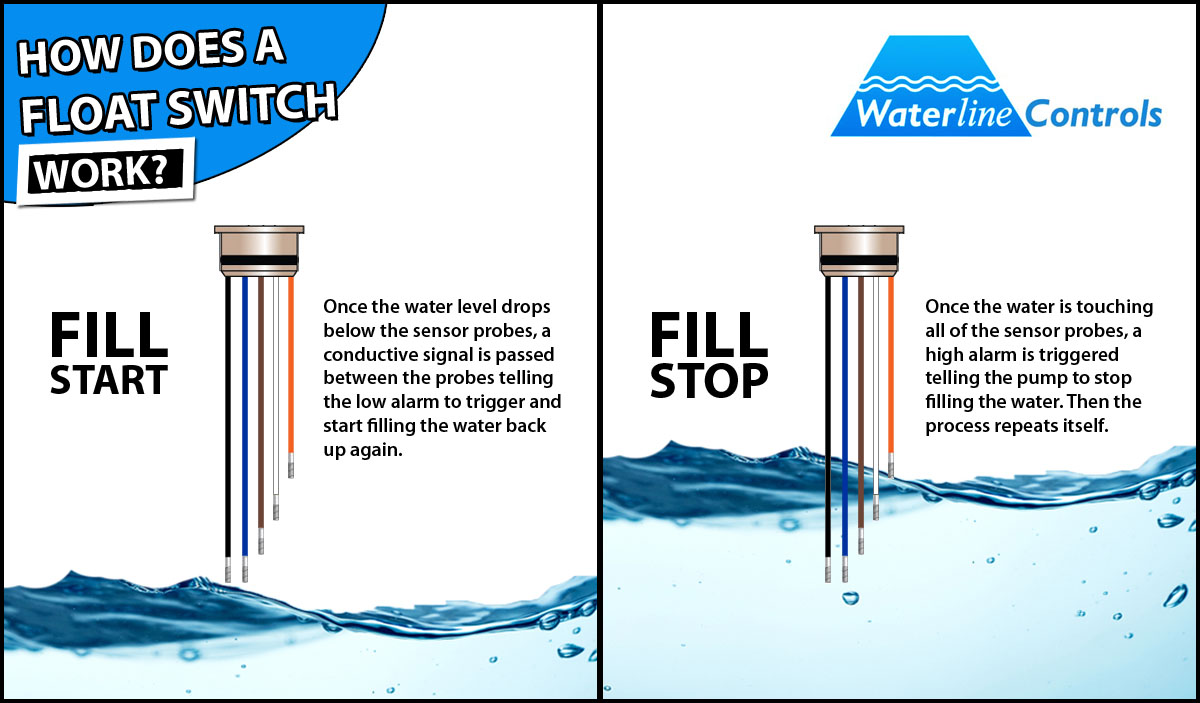
The unit’s head houses all of the controller’s electronics, allowing for direct connection to your control panel. One of the six alarms (Low Alarm, High Alarm, Fill Start, Fill Stop, etc.) will sound as soon as one of the sensors detects the water level. Your water level control system can be configured to sound a single point or multi-point alarm, depending on the type.

The various start and stop mechanisms are managed by different alarms. For instance, if a water tank’s low alarm was set off, it could do one of two things (or both in some setups).

Your control board’s LED light will turn on in response to a low alarm in a single point float switch.
A low alarm will activate the LED light on a multi-point float switch. It will also send a signal to turn on or off a water pump automatically, refilling or emptying the water to the pre-programmed level.

Typically, water level controls and float switches are initially closed, which means that since the water level is at the set height, no alarms need to be set.


Why Choose Water Line Controls

All of our water level controls and water level control systems are assembled right here in the U.S.A. where we monitor every step of the process. The are many reasons to choose Waterline Controls™ for all of your float switch and water level controller needs include:

SIMPLE DESIGN

No moving parts or mechanical floats to break or rust!

BEST TECH SUPPORT

No runaround, no guessing, no stupid answers. You’ll talk to the guy who’s been designing and installing these units for over 20 years.

BUILT TO LAST

Makes it easy to integrate with existing Building Management Systems and has an expected useful life of 15 years.

TOUCH TO TEST

One push of the button starts a complete validation cycle to ensure all systems are working properly.

RELIABLE & ACCURATE

Will not foul, plate, or deteriorate regardless of water quality.

How Waste Water Treatment Works
Written by webtechs

Water Tank Sensor Prices: A Comprehensive Guide

The price of water tank sensors can vary significantly based on the type, features, accuracy, and brand. Here’s a comprehensive guide to water tank sensor pricing to help you choose the right option for your needs and budget:


Types of Water Tank Sensors and Their Price Range

  1. Float Sensors:
    • How They Work: Use a floating device that rises or falls with the water level to trigger a switch or signal.
    • Price Range: $10–$50 (basic models), $50–$100 (advanced models with multiple floats for precise readings).
    • Applications: Residential tanks, irrigation systems.
  2. Ultrasonic Sensors:
    • How They Work: Emit ultrasonic waves to measure the distance between the sensor and the water surface.
    • Price Range: $50–$300.
    • Applications: Industrial water tanks, commercial setups requiring non-contact measurement.
    • Features: Accurate, non-invasive, and suitable for harsh environments.
  3. Conductivity/Capacitive Sensors:
    • How They Work: Detect water level based on the conductive or capacitive properties of the liquid.
    • Price Range: $20–$150.
    • Applications: Water purification systems, small tanks, and electronic circuits.
  4. Pressure Sensors:
    • How They Work: Measure water pressure at the bottom of the tank to calculate the water level.
    • Price Range: $30–$200.
    • Applications: Deep water tanks, underground reservoirs.
  5. Radar Sensors:
    • How They Work: Use radar waves to measure water level without physical contact.
    • Price Range: $200–$1,000 or more.
    • Applications: Industrial and high-precision setups.
    • Features: High accuracy, works in extreme temperatures, suitable for large tanks.
  6. Smart Sensors:
    • How They Work: Combine sensor technology with IoT features for remote monitoring via apps or cloud platforms.
    • Price Range: $100–$500.
    • Applications: Smart homes, advanced industrial systems.
    • Features: Wireless connectivity (Wi-Fi, Bluetooth), real-time data, and alerts.

Factors Influencing Water Tank Sensor Prices

  1. Type of Technology:
    • Basic mechanical sensors are cheaper than advanced ultrasonic or radar sensors.
  2. Accuracy and Range:
    • Sensors with higher precision and longer range tend to cost more.
  3. Build Quality and Materials:
    • Sensors made with corrosion-resistant materials (e.g., stainless steel) are pricier but more durable.
  4. Brand Reputation:
    • Established brands often charge a premium for reliability and customer support.
  5. Additional Features:
    • Features like remote monitoring, multiple output options, or compatibility with existing systems can increase costs.
  6. Size and Application:
    • Industrial-grade sensors are usually more expensive due to their robust design and advanced features.

Popular Brands and Their Approximate Pricing

  1. Honeywell: $100–$400 (advanced pressure and ultrasonic sensors).
  2. Siemens: $200–$1,000 (industrial radar and ultrasonic sensors).
  3. Xiaomi or Smart Home Brands: $50–$200 (IoT-enabled sensors for home use).
  4. TankMate: $50–$150 (affordable float and smart water level sensors).
  5. Omron: $30–$300 (versatile pressure and float sensors).

Where to Buy Water Tank Sensors

  1. Online Retailers:
    • Amazon, eBay, and Alibaba often offer competitive pricing and variety.
  2. Specialized Stores:
    • Plumbing and industrial supply shops for professional-grade sensors.
  3. Direct from Manufacturers:
    • For bulk purchases or custom specifications.

Budget Recommendations

  • For Residential Use: $20–$100 (float or basic ultrasonic sensors).
  • For Smart Homes: $100–$300 (IoT-enabled smart sensors).
  • For Industrial Applications: $300–$1,000+ (radar, high-precision ultrasonic, or pressure sensors).

Additional Costs to Consider

  • Installation: $50–$200, depending on complexity.
  • Maintenance: Periodic cleaning and calibration costs, especially for advanced models.
  • Accessories: Mounting brackets, power supplies, and connection cables.

By understanding the types, features, and price ranges of water tank sensors, you can select one that meets your specific needs and budget while ensuring long-term reliability and functionality.

How Waste Water Treatment Works
Written by webtechs

HOW MUCH DOES IT COST TO REPLACE A POOL PUMP?

Many people like lounging in their houses’ swimming pools during the sweltering summer months. Homeowners start thinking about replastering their pool when the interior starts to appear ugly. A malfunctioning filtration system could be the cause of the pool’s ugly appearance. In one way or another, as a crucial component of the pool’s filtration system, you must be aware of the cost of replacing a pool pump.

COST OF POOL PUMP REPLACEMENT

Having a swimming pool requires you to perform routine maintenance, such as heater repairs, pool pump replacements, and liner repairs. A maj component of the filtration system in a pool is the pool pump, which eventually wears out. High-quality pool pumps require replacement every eight to twelve years on average.

The cost of the replacement pump, which can range from $150 to $1,000 or more depending on the kind and size of the pool, is the only expense associated with do-it-yourself pool pump replacement. Labor, which may add up to an additional $100 to $300, is included in the price when employing a professional.

A POOL PUMP’S REPLACEMENT TIMINGS

A pool pump consists of two main components: the pump mechanism and the motor mechanism. Any of them could falter and require your care. A pool pump may need to be replaced if it has completely failed, is leaking water, produces loud grinding or screaming noises, or is no longer able to move water.

REPLACEMENT OF A POOL PUMP OR MOTOR

Replacing simply the motor might be a viable option if the pool pump is relatively young (less than ten years old) and the pump’s exterior doesn’t exhibit any symptoms of deterioration. Replacing the entire pump is the best option if it’s an older pump, the motor replacement components are difficult to acquire, or the cost of the replacement exceeds 75% of the cost of a new pump. The entire pool pump should be replaced if it is still covered under warranty.

Replacing the motor alone will save you more money than replacing the entire pool pump. Hiring a professional can cost an extra $100 to $200 on top of the $50 to $400 cost of a do-it-yourself engine replacement.

CHOICES FOR POOL PUMP REPLACEMENT

Conventional pool pumps use single-stage motors, which are quite energy-hungry. The U.S. Department of Energy estimates that the typical device uses approximately $500 worth of electricity annually. Modern technology allows two-stage motors and adjustable-speed units to operate at speeds as low as 600 RPM and consume up to 90% less energy than their conventional counterparts. Additionally, most of the time, they work with automated home systems.

BUY A PROFESSIONAL OR DO IT YOURSELF?

It takes some comfort level and basic electrical understanding to replace a pool pump. Neglecting to implement suitable safety measures or improperly wiring the newly installed pump may result in severe harm, impairment of the pump, or other forms of property loss. Replacing a pool pump would not be a good choice if you are uncomfortable working with electricity; instead, you should think about contacting a competent pool professional.

Replacing a pool pump could be an easy do-it-yourself project if you’re experienced working with electricity. You can save money by not having to pay for labor.


Never Replace Liquid Level Sensors Again with Waterline Controls™

Our level sensors and controls aren’t just for use in residential potable water holding tanks; some of the other applications include cooling towers, sump pumps, wastewater, boilers, water storage tanks, and building fire protection water tanks.

1 2