
Cooling Tower Vs Chiller
Written by webtechs

Cooling Tower Vs Chiller

Cooling towers and chillers are both used in HVAC systems to remove heat, but they operate differently and are suited for different applications. Here’s a comparison to help understand their functions, advantages, and disadvantages:

Cooling Tower

Function: A cooling tower is a heat rejection device that extracts waste heat to the atmosphere by cooling a water stream to a lower temperature.

Working Principle:

  • Evaporative Cooling: Water is pumped to the top of the cooling tower and sprayed over a heat exchange surface. As the water flows down, air is drawn through the tower, causing some of the water to evaporate. This evaporation cools the remaining water, which is then recirculated through the system.

Applications:

  • Used in industrial processes, large commercial buildings, and power plants where large amounts of heat need to be removed.
  • Common in HVAC systems for cooling buildings.

Advantages:

  • Energy Efficient: Uses less energy compared to chillers for the same cooling capacity.
  • Cost Effective: Lower operating costs due to lower energy consumption.
  • Effective for Large Systems: Suitable for large-scale cooling applications.

Disadvantages:

  • Water Consumption: Requires a constant supply of water, which can be a concern in water-scarce regions.
  • Maintenance: Needs regular maintenance to prevent issues like scaling, biological growth, and corrosion.
  • Climate Dependency: Efficiency can be affected by ambient temperature and humidity.

Chiller

Function: A chiller removes heat from a liquid via a vapor-compression or absorption refrigeration cycle. This liquid can then be circulated through a heat exchanger to cool air or equipment.

Working Principle:

  • Vapor-Compression Cycle: Uses a refrigerant to absorb heat from the water in the evaporator. The refrigerant is then compressed, which increases its temperature, and the heat is rejected in the condenser. The cooled refrigerant is then expanded and circulated back to the evaporator.
  • Absorption Cycle: Uses heat energy (from steam or hot water) to drive the refrigeration process, which is more common in specific industrial applications.

Applications:

  • Used in smaller commercial and residential buildings.
  • Common in HVAC systems for precise temperature control.
  • Suitable for applications where water is not readily available or where water conservation is important.

Advantages:

  • Versatility: Can be used in a wide range of applications, including precise cooling for manufacturing processes.
  • Water Conservation: Does not require a continuous water supply like cooling towers.
  • Climate Independence: Less affected by ambient weather conditions compared to cooling towers.

Disadvantages:

  • Energy Consumption: Generally uses more electricity compared to cooling towers, leading to higher operating costs.
  • Initial Cost: Higher upfront costs due to the complexity of the system.
  • Maintenance: Requires regular maintenance, especially for the refrigeration components.

Comparison Summary

  • Energy Efficiency: Cooling towers are generally more energy-efficient than chillers.
  • Water Use: Cooling towers consume more water, while chillers are more water-efficient.
  • Application Size: Cooling towers are suitable for large-scale applications, whereas chillers are better for smaller, precise cooling needs.
  • Climate: Cooling towers are more effective in dry climates, whereas chillers can operate effectively regardless of the climate.
  • Cost: Cooling towers typically have lower operating costs but may have higher water costs. Chillers have higher energy costs but are more versatile in applications.

Choosing between a cooling tower and a chiller depends on the specific cooling needs, available resources, and environmental considerations of the application.

Altitude Valve
Written by webtechs

Replace Altitude Valves with Modern Controllers

Replace Altitude Valves with Modern Controllers

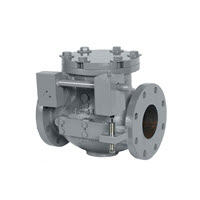
Many ground level or elevated water storage systems use what is known as an Altitude Valve. These valves close at a preset high-level to prevent overflow of water in a ground storage tank or reservoir, opening to refill the water in the tank or reservoir as the level lowers. In crude systems they are reliable and effective.

Modern water storage requirements are not usually well served by such stand-alone devices though.

Fire Safety Water Holding Tanks

For fire protection, a much more effective, less temperamental and less expensive solution is an electronically operated system that connects to automated building management systems, has alarms, or even redundant switching and alarms.

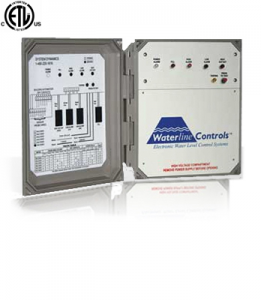
FPT50 ControllerA better solution for Fire Safety holding tank systems, and a replacement for them, is the Waterline Controls WLC FPT-50. This Fire Service Water Tank Level Control with high and low alarms gives you modern, state of the art control, visible and audible alarms, and peace of mind.

Our systems come with a modern, intrinsically safe, electronic sensors. Our systems connects to a BAS or building management system for many modern code requirements, or just logical safety precautions.

Cooling Tower Vs Chiller
Written by webtechs

Identifying Water in Transit in Cooling Towers

Identifying Water in Transit in Cooling Towers

While our system is simple to use and install, some theories and terms can be good to review before proceeding. With this in mind, let’s talk about the ‘hidden’ water in a typical cooling tower system. The terms we will be talking about here are “Freeboard” and “Water in Transit”.
Freeboard – This is a civil engineering term used to describe the distance between the normal operating level of an environment and the space allowable to fill without overflowing any reservoir. For our purposes we will use this term to describe the distance between the minimum operating level (that is an acceptable level to allow all the other features and functions of the system to operate properly, such as pumps and valves and piping) and the overflow level (the point at which it dumps to waste and cannot be recovered).
Water In Transit – Describes the water moving through the system while it is operating, that has the potential to get back to the basin/holding tank and filling the freeboard.

Needed Calculations

[easy_cal]

How to calculate and evaluate freeboard and water in transit
The needed space can be calculated by measuring the water in transit in gallons and then figuring how much space is needed inside the basin/tank.

  1. Calculate the volume in the pipes by using the volume of a cylinder formula where the measurements are in feet.
  2. Multiple that cubic dimensions by 7.5 (since there are 7.48 gallons of water in a cubic foot).
  3. Calculate how much water is in every inch of the tank by using Length x Width x 0.0833 x 7.5 or using the volume formula where the height of 1” = 0.0833Ft.

The rule of thumb for cooling tower water in the system is one half of the GPM of the tower.

Verification

This is a good estimate and now it should be validated by setting a level in the tank as a minimum operating level and see if there is going to be enough freeboard to capture the water in transit. We all tend to want an extra 2 or 3 inches for whatever reason so add the space if you have it. This freeboard will be required to capture this water every time the system turns off. When or if the demand changes because someone adds more piping (equals more water in transit) or more water capacity in any form then the required freeboard changes in the same manner.

Dangers of Older Level Control Systems

Corrosion capacitive sensor

Corrosion on a capacitive sensor – typical after ! year


Just because the system is adding water it does not mean that the volume of water is increasing. The water that is being added is caused by the need to dump water or water evaporating, so water in is equal to water out. Typically, setting a water level in these types of environments should not be set up on a long term basis with a mechanical float switch of any sort, you should use a system like WaterLine Controls. The reason is because float switches are mechanical and set to operate at the minimum operating level but whenever the system is turned off the float switch is stressed in the opposite direction. This occurrence over time affects the set point but also has the potential for mechanics of some float switches to fail, allowing water to run freely into the tank and out the overflow.
With our WLC System there are no floats in the water, it is a sensor driven system where the water is free to move up and down the probes and this up and down movement has no effect on the probes since they do not move. Also, with a WLC system, there is the ability to send the sensor activation points to an automation system or BAC so the set points in the tank can been “seen” electronically and acted upon, if necessary – That cannot be accomplished with a mechanical float.

Some Real World Examples

Recently, we have been running into cases where the operator is replacing an old water level controller that either had water volume control issues in the past or the demand on the system has changed because someone has added volume requirement capacity. When they go to put a WLC unit in, or for that matter any level controller back in, every time the system turns off the cooling tower basin/holding tank overflows into the drains and the excess water then goes to waste.
We have been told many stories about these catastrophic float switch failures where companies lose tens of thousands of gallons of water and thousands of dollars. This next example is where the demand had changed and the level was dropped to accommodate the change. In this case the water was set in the original design to be an air barrier so as to force all the air through the fill material. When they lowered the level that barrier disappeared and air would now take the least path of resistance under the fill between the fill and the water level. More airflow along the bottom caused the fill to dry out since there was now more airflow across this area from lower resistance. This now caused all of those other issues related to dried out fill and poor air movement through the fill reducing efficiency. The only way to make this operate as designed is to add an external tank to capture the added water in transit.

blank
Written by webtechs

Fountain Water Level Control and Sensors That Last

Fountain Water Level Control and Sensors That Last

Water FountainWater Fountains need to be accurately controlled to assure proper and continued function. The level of water required to keep the fountain from either running dry or overflowing is very important to monitor and maintain. Low water can cause pump damage or fountain failures, while floods from overflowing can be even more disastrous. We could help cover all that…and much more.
Fountains are usually in a public place, where you want the equipment out of sight…and touch, not in the view of onlookers, taking away from the experience. Our sensors can be located in an external static well to remove the sensing probe from sight.

You also need a safe system. Our sensors run on low voltage and low current. In fact, all of our products are ETL Listed to the industrial Controls UL Standard 508. You can check out our Fountain Systems here.

SensorsElectronic Liquid Level Control

What Kind of Sensor is the Best? Ask our customers!
We recently spoke with a fountain Contractor/Supplier in Los Angeles and got a great testimonial we thought we’d share.

He was telling us about a job he had been on recently…

Client Testimonial-

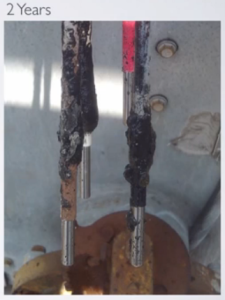
While attending to a fountain he had the chance to observe a Waterline electronic sensor. He was surprised by its appearance, thinking it look new, when he knew it was not. He said it had had our controller and sensor for 20 years and “it looks like it has never been in the water, it was so clean.” Ever seen the corrosion on conductivity probes or the pitting that occurs? Our sensors don’t suffer from that. We use a sensor that contains multiple stainless steel probes that are inserted into the liquid being measured.

We proudly told the contactor that here was the difference between our product and conductivity type probes. We told him that a 10 year old probe like the one he encountered can look almost brand new still. He went silent of a minute, and then exclaimed happily, “Wow, I never realized that until just now!”

Conductive Sensor

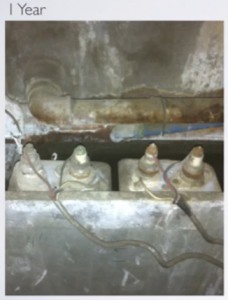
Corrosion on conductive sensor

Corrosion on a conductive sensor, typical after 1 year

Waterline Sensor

Waterline Controls Sensor

Even with bad water quality
tips of the probe look new!

Controllers

You also need to control your water supply. Waterline controllers are designed to operate 110VAC solenoid valves and connect into a larger control panel to let the pool or fountain operator know what the water level controls are doing. Building Automation System– With BAS connection capability our revolutionary software driven solid state electronic controllers are the cutting edge for water level control. We have systems with High & Low Alarms and Low-Low Basin Heater Cut-off, for fool-proof operation. Testing is simple and intuitive, with just a push of a button.control (Duplicate)

The Sum is Greater Than the Parts

And some great parts they are. With little maintenance, low cost, long life and integrated firmware for hassle free operation, we think we have the only system you’ll ever need for keeping a beautiful and expensive water fountain running economically, safely and automatically for many, many years to come. Back that up with our industry leading 100% satisfaction guarantee and you simply can’t lose!

External Static Pipe
Written by webtechs

Choosing the Right Water Level Sensor

Choosing the Right Water Level Sensor

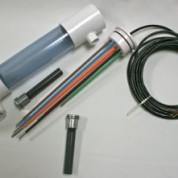
Very basically, a water level sensor detects the level of water in a container. Our water level systems use Electronic Sensors for determining the volume of water in a tank. They can replace old systems with mechanical float switches and Capacitive, Conductive or Ultrasonic sensors.

There are lots of water level sensor systems available today. The challenge is in choosing the right system. You need ease of use. You’ll need to easily integrate with your existing systems. You need to monitor and, finally, control it.

It is important to select a water control sensor that has an intuitive monitoring system. Ours feature LED indicators and easy to use push button systems. If the sensor can work on autopilot, then you reduce the need for continuous manual monitoring. We say ours system is “so complete you don’t need to be there.” With our controllers and sensors you have a complete level detection and filling system which is fully automatic.

Durability is another important factor to consider in a water level sensor. We build systems so they can last for many decades. A modular design will also let you fix individual parts when needed, eliminating the need for a complete replacement. You will never have to replace the entire unit again, simply replace the appropriate part. This kind of design can substantially reduce the cost of maintenance and operation. We have a 100% satisfaction guarantee. If it doesn’t work we will take it back – period. This kind of guarantee shows we are very confident about the effectiveness of our system.

Made in the USASafety

Waterline systems utilize a low voltage, which avoids injuries and serious accidents. A low-voltage / low-amp system totally eliminates the possibility of electric shock. During installation and maintenance, you are safe from accidents due to high sensor voltages. Our sensors are listed to UL508 Standard by ETL.

Sensor Types

The types of sensor you see in today’s market are generally Mechanical, Capacitive, Conductive and Ultrasonic. All of these have many drawbacks, reliability issues, corrosive issues, voltage issues or cost and calibration issues. In an application that contains diesel or certain coolants we do recommend using mechanical float switches. We have developed our own magnetic reed switch that connects directly with our WLC Series controller when needed.

New Technology

Waterline Controls designed and created completely new electronic switch sensor that runs on software. In conjunction with our automatic controllers, with models designed for many markets and application, we offer a complete, simple, and reliable solid state electronic level control system that is also very cost effective.

Our water level sensors are built to last, withstanding harsh conditions, compensating for waves, and maintaining an accuracy within 1/8″ of operating range.

Waterline Controls
Written by webtechs

Waterline Controls Acquires Trademark

Waterline Controls Acquires Trademark

After six years of waiting, Waterline Controls has finally received its trademark. When System Dynamics, Inc was developing Waterline Controls back in October of 2008, President Bill Seneff applied for a trademark of the name “Waterline Controls” to the United States Patent and Trademark Office (USPTO). After almost ten months of processing, the trademark request was denied. During five years of growing Waterline Controls business into the product line it is today, Bill Seneff had the Waterline Controls’ logo created and developed the WLC Level Controllers into a popular and recognizable brand. In August of 2013, both Waterline Controls’ name and logo were resubmitted for review by USPTO. There was no opposition, and the trademarks were officially registered on August 19th, 2014. You can find both the logo and the name trademarked at www.uspto.gov under their registration numbers 4587419 and 4587400 respectively.